
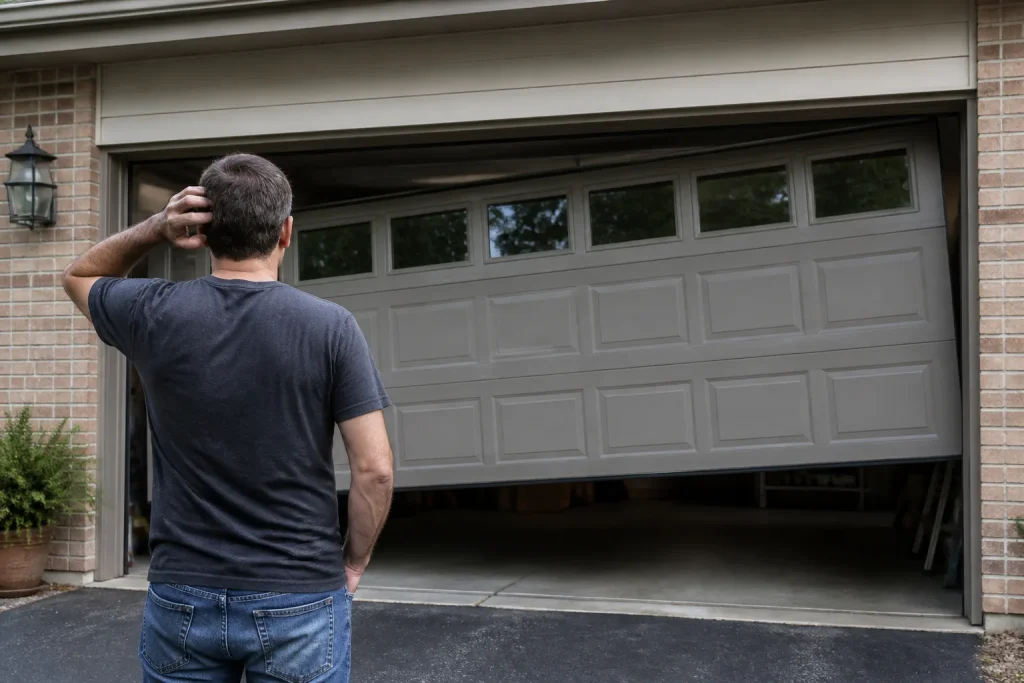
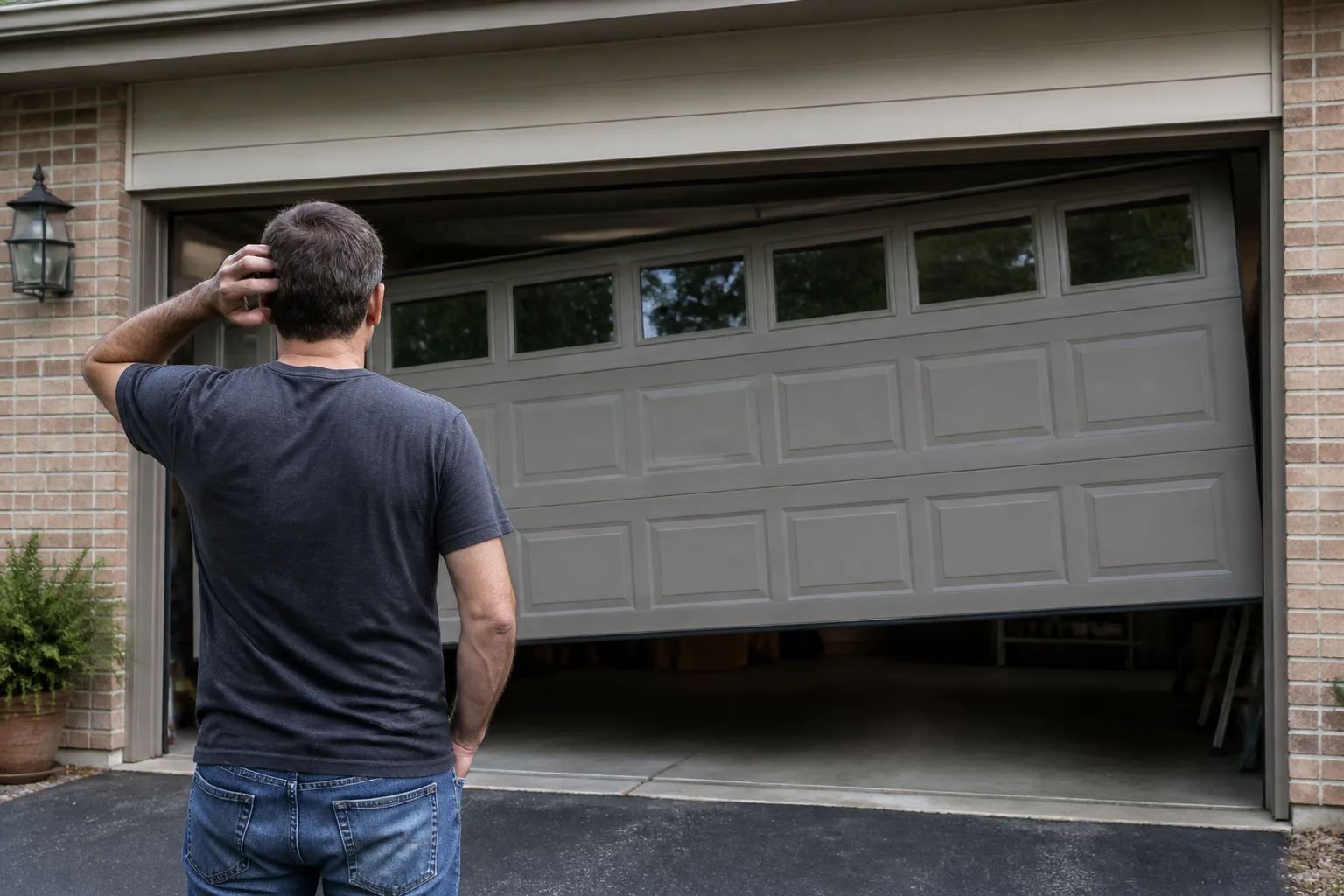
Top Signs You Need Garage Door Service – Don’t Ignore These
The clearest signs you need garage door service in Naperville are a door that has slowed down, a grinding or popping noise that wasn’t there before, a door that drifts or reverses before closing, and any visible gap in the spring, cable, or track. These are mechanical signals, not old age, and most of them get louder before they get cheaper. If you’d rather not poke at a loaded torsion system yourself, call (866) 947-9076.
A garage door that takes four seconds longer to open than it did six months ago isn’t “getting old.” It’s a motor working harder to compensate for a spring that has lost tension, and that motor will fail within 60 to 90 days if the underlying cause isn’t addressed. That’s the thing most homeowners miss: the slow door is a symptom, and the motor is the thing about to break because of it.
Which Noises Mean “Lubricate It” and Which Mean “Stop Using It”?
A squeak or squeal usually means dry rollers or hinges and is the one noise on this list you can live with briefly. Grinding, popping, and snapping are different animals. They point to worn bearings, a roller coming out of its bracket, or a torsion spring winding down unevenly. Those are the sounds that turn into emergency calls, and in our experience they get there faster in Naperville once repeated freeze-thaw cycles start working the metal loose.
- Squeak or squeal – dry rollers, hinges, or a dry opener rail. Low urgency, worth a light lubrication with a proper garage door lubricant (not WD-40 as a stand-in).
- Grinding that rises and falls – worn rollers or a bearing starting to seize. The opener is pulling harder than it should every cycle.
- A sharp pop, then silence – often a torsion spring letting go. Stop operating the door.
- Rattling from the top of the door – loose brackets or a cable that has jumped its drum. Do not keep cycling it.
That last one is where we’d draw the line ourselves. A rattle you can trace to a hinge bolt is a Saturday project. A rattle from the header, where the springs and cables live, isn’t a project – it’s a stop-and-call. Our technicians have up to 15 years of experience diagnosing these by ear and by brand behavior, because a Craftsman opener with a grind sounds different from a LiftMaster with one.
Why Is Door Speed the Most Reliable Early Warning?
A door that opens slower, closes faster, or moves at an uneven pace is telling you about spring and cable wear before anything actually breaks. Speed is the most accurate early-warning indicator you have, because it reflects the balance between the springs and the opener – and that balance shifts gradually, so homeowners adapt without noticing.
Here’s what a change in speed usually means in practice:
- Slower to open: the torsion spring has lost tension and the opener is doing work the spring used to do. Left alone, the motor burns out.
- Faster to close, or slams down: the spring is over-tensioned or a cable has slipped. This is a safety issue, not an inconvenience.
- Uneven, one side lagging: a cable is fraying or a drum is out of adjustment. Cables are under extreme tension and should never be adjusted by a homeowner.
- Starts and stops mid-travel: could be the spring, the opener’s force setting, or a travel limit that’s drifted. The right fix depends on which.
If you notice any of these, check the door by hand with the opener disengaged. A properly balanced door should lift with one hand and hold position at roughly halfway open. If it won’t, the springs are the problem, and that’s the right fix for your specific door.
The 30-Second Inspection That Catches Most Developing Problems
With the door closed, stand inside your garage and let your eyes run up the center, then across the top, then down both sides. That 30-second visual pass catches roughly 80% of developing problems before they become emergency calls – and it’s the most useful habit we can give a Naperville homeowner.
- Look at both springs. A torsion spring should look uniform along its coil. A visible gap, a stretched section, or a fresh rust streak means it’s failing.
- Look at the cables. They should run straight and clean from drum to bottom bracket. Fraying, kinks, or a cable sitting slack means stop operating the door.
- Look at the tracks. Dents, bends, or a gap between the roller and the track edge cause the door to bind.
- Look at the panels and hinges. A hinge pulling away from the panel or a bottom bracket with play is a warning sign.
- Look at the opener rail and the wall mount. A sagging rail or a bracket pulling out of the ceiling joist is unsafe.
Do this from a standing position. Don’t reach into a moving door or torque on a spring to “see if it’s loose.” Torsion and extension springs store serious energy, and the only safe hands on them are trained ones with the right tools. When your spring breaks, your door doesn’t just stop – your day does, and that’s not a job for advice from a video.
Your Sensors Are Fine. So Why Won’t the Door Close?
Most “opener problems” in Naperville are actually photoelectric sensor problems in disguise. The door starts down, reverses, and the opener gets blamed. The fix is usually two eyes that are misaligned, dusty, or blocked by a broom handle nobody noticed.
You can tell the difference in 60 seconds. If the opener’s light blinks a set number of times when it reverses, that’s the opener reporting a sensor fault, not a motor fault. If the door reverses but the light pattern stays steady, look at the opener’s force settings or a binding track. And if the wall button works but the remote doesn’t, that’s neither sensor nor motor – it’s the remote, its battery, or its programming.
We see this most with older Craftsman and Genie systems where the sensor bracket has been bumped by a recycling bin one too many times. Sensors are a cheap, fast fix. Opener motors aren’t, which is why telling the two apart first matters. If the diagnosis points at the opener itself, that’s a separate service from a mechanical door problem, and it’s worth having a specialist look rather than swapping parts.
Which Warning Signs Can Wait, and Which Can’t?
A squeak, a cosmetic dent, a single remote losing range, or a slow-closing door with no other symptoms can usually be monitored for one to two weeks. A broken spring, a frayed or slack cable, a door stuck off its tracks, or a door that reverses unpredictably should not be operated until a technician inspects it. The line between the two is simple: is the door still balanced, and is anything under tension or hanging loose?
The ones that wait: a noisy hinge you can trace, a remote that’s been dropped, a panel scuff, or a sensor knocked slightly out of line (fixable in a minute). The ones that don’t: a snapped spring, a door that’s come off one track, a cable hanging loose, or a door that won’t stay at halfway. Running a door with a broken spring loads the opener with the full weight of the door, which is how a repair turns into an opener replacement. And if the door is stuck open, the house is open – that’s a same-day thing, not a next-week thing.
If you’d rather not DIY the diagnosis, call (866) 947-9076. We answer 24/7. Fast dispatch from 7am to 7pm, Sunday through Friday.
The Bottom Line
Listen to the door, watch its speed, and run the 30-second inside inspection every few weeks. The slow door, the grinding noise, and the sensor blink are all messages, and the cost of ignoring them is usually a bigger repair. Which signs are just symptoms and which are emergencies comes down to balance and tension – and you can judge both by hand in under a minute.
If you’re in Naperville and need help, Naperville Garage Door Repair Pros offers free estimates – call (866) 947-9076. Our technicians have up to 15 years of experience and are factory-familiar with the eight brands most often installed in local homes, including Amarr, Wayne Dalton, Craftsman, and Raynor, so we diagnose by brand behavior rather than guesswork. Whether you need garage door repair, a dedicated garage door opener repair, or a full garage door installation, it’s all under one provider – no referral handoffs. And everything starts at our Naperville Garage Door Repair Pros home page, where you can see the full service list. Emergency garage door service is a core offering, not an upsell – the price is set per job by the written estimate, quoted before any work starts. The written estimate sets the final price, and the estimate itself is free.
Related services in Naperville
If your inspection points to a specific problem, our garage door repair, garage door opener repair, and garage door installation pages cover what each service involves and what it typically costs.
Frequently Asked Questions
A visible gap, a stretched section, a fresh rust streak, or a door that feels heavy when you lift it by hand with the opener disengaged are all signs a spring is about to fail. Stop operating the door and have it inspected. Call (866) 947-9076 for a free estimate – the written quote is set before any work starts.
Not usually. A squeak or squeal from dry rollers or hinges is a lubrication issue you can monitor for a week or two. Grinding, popping, or rattling from the top of the door near the springs and cables means stop and have a technician look – those point to worn bearings, seized rollers, or tension problems that get worse with every cycle.
You can, but the wiring, force settings, and travel limits have to be matched to the door’s weight and balance, and a mistake there is a safety issue. Most Naperville homeowners are better off with the right fix for their specific door. Call (866) 947-9076 and we’ll quote it in writing before any work starts.
A quick visual pass every few weeks and a professional tune-up check now and then keeps small problems from becoming emergency calls. Balance, spring condition, cable wear, and sensor alignment are the four things to check. If you’re in Naperville and want to know what you’re looking at, our technicians have up to 15 years of experience and will walk you through it – call (866) 947-9076 for a free estimate.
Written by the team at Naperville Garage Door Repair Pros.
Need Garage Door Help?
Call Naperville Garage Door Repair Pros - the local pro we connect you with is licensed and insured, here with fast help in Naperville.
(866) 947-9076