
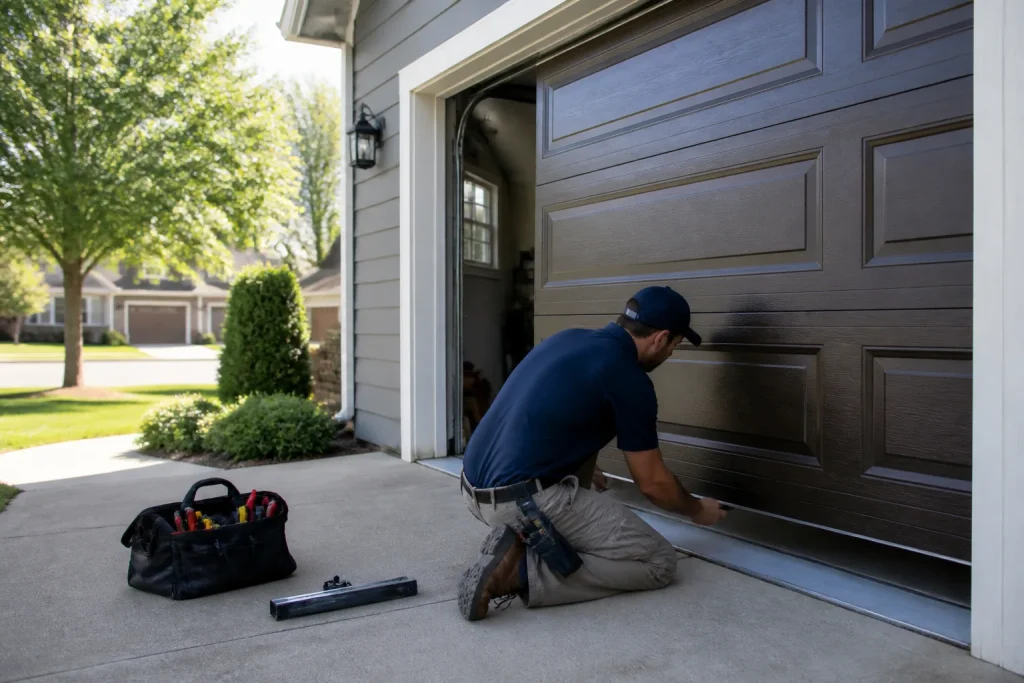
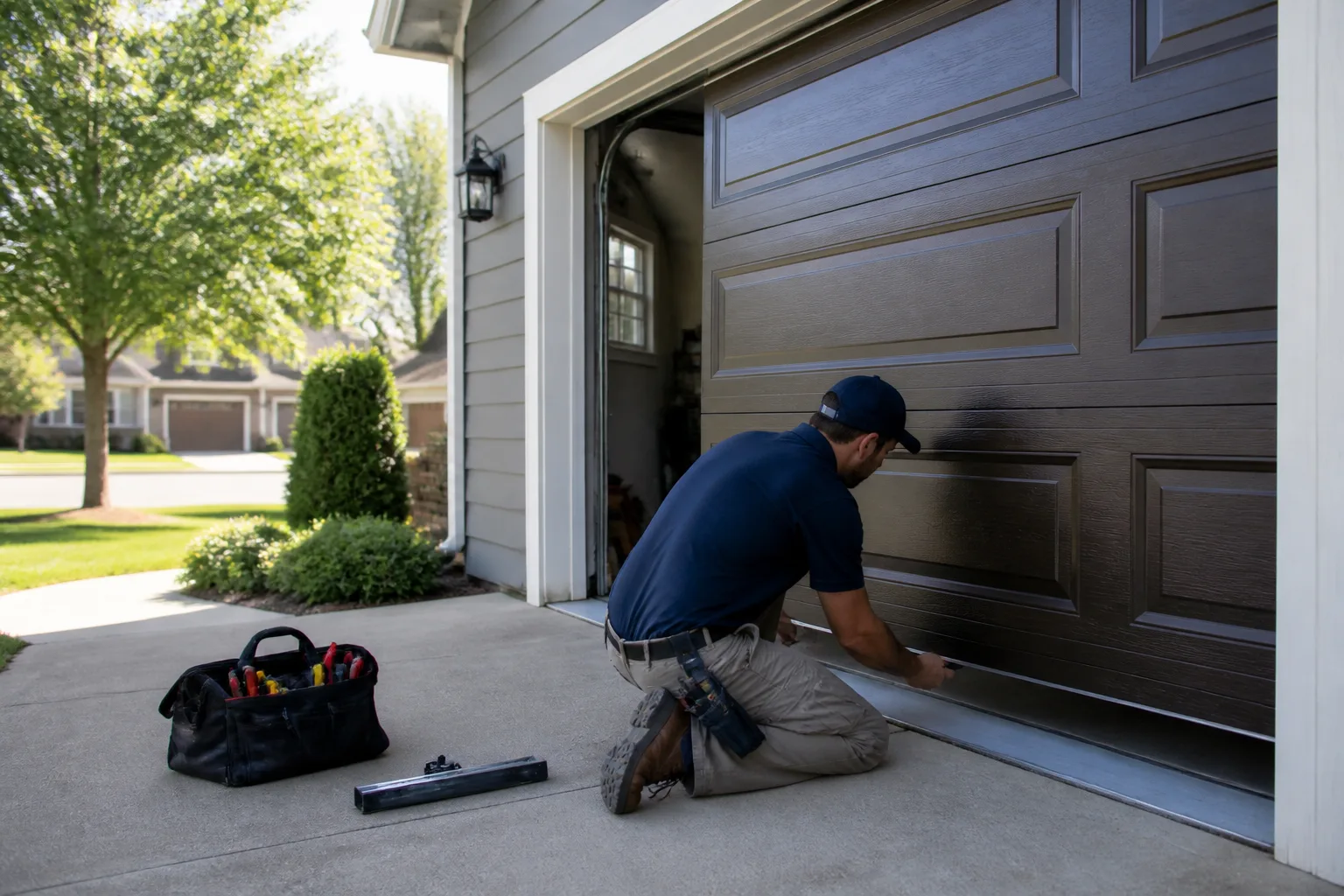
Clopay Garage Door Repair in Naperville: A Homeowner’s Guide
Clopay door sections look interchangeable. They aren’t. Put the wrong gauge replacement panel on a Canyon Ridge or Gallery series door and you create a stress imbalance that quietly eats away at the spring on the opposite side. In Naperville, where Clopay is the most common residential door we see, that single mistake causes more repeat repair calls than any other. This guide covers the Clopay-specific failure points that reward brand knowledge and punish guesswork, from hardware weights to weatherseal profiles.
If you’d rather not sort through all of this on your own, call (866) 947-9076 and we’ll walk you through what your door actually needs.
Why Clopay Doors Need Brand-Specific Repair in Naperville
Clopay builds several distinct product lines, and the hardware inside them varies meaningfully. A Classic series steel door and a Canyon Ridge carriage-house door may look like cousins from the curb, but the section weights differ enough that spring and cable sizing has to be matched to the actual door, not to a generic spec sheet. When a technician treats every Clopay as the same door, the springs end up under- or over-tensioned, the cables carry load they weren’t sized for, and the whole system wears faster.
In our experience across Naperville, this is where brand familiarity separates a real specialist from a generalist. We work on Clopay regularly and diagnose by how that specific line behaves, not by what usually works on steel doors in general. We also handle Amarr and Wayne Dalton doors, which have their own quirks, so the brand-first approach applies across the board.
Here’s what brand-aware Clopay diagnosis actually examines:
- Section weight and gauge – confirms the replacement panel matches the original, so the door stays balanced.
- Spring sizing – torsion or extension springs matched to the actual door weight, not assumed from the model name.
- Cable condition – lift cables checked for fraying and correct tension after any panel or spring work.
- Track alignment – a heavier or lighter section changes how the door rides the track.
- Bottom rail profile – checked before ordering any weatherseal, because Clopay profiles aren’t universal.
Each of these takes minutes to check and prevents the kind of mismatch that shows up as a new problem months later.
How Clopay’s Product Tiers Change Spring and Cable Requirements
Clopay’s lineup runs from the Classic collection through Coachman to the Canyon Ridge line, and the hardware weights climb as you move up. Insulated doors are heavier. Carriage-house styles with overlays and decorative hardware add weight in places a plain steel door doesn’t. That extra mass has to be carried by springs sized for it, and by cables rated for the load.
What goes wrong: a homeowner replaces one damaged panel with a section from a different tier, or a technician installs springs spec’d for a lighter door. The door may open and close fine at first. Then the imbalance starts working on the opposite spring, the cables take uneven strain, and the whole assembly ages prematurely.
For Naperville homeowners, the practical takeaway is simple. Any spring or cable replacement on a Clopay door should start with identifying the exact line and confirming the door’s weight. A written estimate should reflect that. We quote the price and agree it with you before any work starts, so there’s no surprise when the invoice arrives.
Common Clopay Panel Damage in Naperville and When Replacement Makes Sense
Two damage patterns dominate Clopay repairs in Naperville. The first is freeze-thaw wear on steel doors. Our winters cycle above and below freezing repeatedly, and that movement works on panel seams, bottom rails, and the paint film at the section edges. Over several seasons you get rust creep along the bottom, bubbling paint, and seams that no longer sit flush.
The second is backing-in damage. A car nudges the door before it’s fully up, and the bottom section takes a dent. Small dents in a single steel panel can sometimes be repaired in place. But when the panel is creased, the section is bent out of plane, or the damage reaches a hinge stile, replacement is the right call, because a bent section throws off the door’s balance and stresses the hardware every cycle.
Here’s how we decide between panel repair and full section replacement:
- Crease depth and location – a shallow cosmetic dent in the panel field is a repair candidate; a crease across a stile or hinge point usually isn’t.
- Section flatness – if the section no longer sits flat in the track, it needs replacing.
- Rust penetration – surface rust can be treated; rust through the steel means the panel is done.
- Matching the gauge – the replacement must match the original section’s gauge and tier, or you create the imbalance described above.
- Age of the door – on an older door, replacing one section can look mismatched against sun-faded neighbors; sometimes a full door makes more sense.
Naperville’s housing stock includes plenty of doors in that middle range where the decision isn’t obvious. A careful on-site look settles it.
Clopay Warranties: What’s Actually Covered in Year 1, 3, and 5
Most Clopay doors carry a limited warranty that’s split by component, and the coverage terms differ by product line. The general structure most homeowners encounter looks like this, though the exact terms depend on your specific model and paperwork:
- Year 1 – the broadest coverage, typically including hardware and mechanical components alongside the door sections.
- Years 2 through 3 – hardware coverage narrows or ends depending on the line, while section coverage continues.
- Years 4 through 5 – section coverage generally remains, but hardware and moving parts are usually outside the window by this point.
What surprises people is how often a valid warranty claim goes unused, simply because nobody checked the original documentation. If your Clopay door is within its coverage window and a section has failed, it’s worth pulling the paperwork before you pay for a replacement out of pocket. We can help you figure out what your door’s warranty likely covers, but the final word comes from Clopay and your original purchase documents. Bring those to the conversation and you’ll get a straighter answer.
Why Clopay Weatherseals Need Brand-Specific Replacement
Clopay’s bottom rail profiles are shaped for Clopay’s own weatherseal designs. Push a generic seal onto that rail and it won’t seat properly. The result is gaps at the floor line, drafts, water intrusion during heavy rain, and a seal that works loose and drags. In Naperville, where winter wind and summer storms both find their way under a poorly sealed door, that gap matters for energy loss and for keeping moisture off the bottom panel.
The fix is straightforward: match the seal to the door’s actual bottom rail profile. It takes a few minutes to identify the right part and saves the cycle of install, fail, replace. If you’re not sure which seal your door takes, a technician can identify it on site. This is one of those small Clopay details that a brand-familiar specialist handles without a second trip.
Clopay Models Common in Naperville Subdivisions and the Maintenance Now Due
Doors installed in Naperville subdivisions between 2010 and 2020 are now hitting the age where maintenance catches up. The models we see most often in that window include Classic series steel doors, Coachman carriage-style doors, and the occasional Gallery or Canyon Ridge installation on higher-end builds. At this age, the typical items coming due are:
- Spring fatigue – torsion springs have a finite cycle life, and a door cycling several times a day reaches the end of it around this age.
- Roller wear – nylon and steel rollers flat-spot and get noisy; replacement quiets the door and reduces track strain.
- Hinge and fastener looseness – vibration loosens hinge screws over the years, and the door starts to shimmy.
- Weatherseal hardening – the bottom seal stiffens and cracks, losing its seal against the floor.
- Cable wear – lift cables fray at the drums and should be inspected before they fail.
If your Naperville door is in that 2010-2020 window, a single inspection can tell you what’s due now versus what can wait. We’d rather tell you a door has another few years in it than sell you a replacement you don’t need. When replacement does make sense, we handle garage door installation for Clopay and other major brands.
When to Call a Pro for Your Clopay Door
Some Clopay fixes are homeowner-friendly: wiping down panels, tightening a loose hinge screw, applying lubricant to rollers and hinges. Others are not. Torsion and extension springs store enormous energy, and a spring under tension can cause serious injury if it’s handled without the right tools and training. Never attempt to adjust, remove, or replace a spring or cable yourself. The same goes for a door that’s come off its tracks or a door with a bent section under load. Call a trained technician for those.
For anything electrical, including opener wiring and safety sensor alignment, we also recommend a professional. If the door is stuck, the spring has snapped, or the opener won’t respond, that’s a call worth making. Our technicians have up to 15 years of experience, and we treat spring repair as a specialty rather than a side job. We handle garage door repair and garage door opener repair as dedicated services, so the diagnosis fits the actual problem.
Related Services in Naperville
If your Clopay door needs more than a tune-up, we cover the full range: spring replacement, panel and section work, opener diagnosis, and new door installation. You can see the full scope of what we do on our Naperville garage door repair pros page. It’s all handled by one provider, with no referral handoffs between trades.
What happens when you call
- 1
A real person answersNo phone trees – you reach a local pro.
- 2
You get an upfront price rangeHonest numbers before anyone is dispatched.
- 3
A background-checked tech heads outLicensed & insured, dispatched right away.
- 4
You approve before work beginsNothing starts until you say go.
The Bottom Line
Clopay doors reward brand-specific knowledge and punish shortcuts. Match the panel gauge, size the springs to the actual door weight, use the right weatherseal for the bottom rail profile, and check your warranty before paying for a replacement section. Those four habits prevent most of the repeat repairs we see on Naperville doors. If sorting through that yourself isn’t how you want to spend your time, call (866) 947-9076. We answer 24/7. Fast dispatch from 7am to 7pm, Sunday through Friday. Naperville Garage Door Repair Pros offers free estimates, and the price is quoted and agreed before any work starts.
Frequently Asked Questions
It depends on the repair. A spring replacement, a panel replacement, an opener fix, and a weatherseal job all price differently, and the exact Clopay model affects parts cost. We give a written estimate before any work begins, so you know the number in advance. Call (866) 947-9076 for a free estimate.
Often, yes, for common repairs like springs and openers. We answer 24/7, and fast dispatch runs from 7am to 7pm, Sunday through Friday. We’re closed Saturday. Call (866) 947-9076 and we’ll book you into the next available opening.
No. The price is set by the written estimate and agreed with you before work starts. If we find something unexpected during the job, we discuss it with you first rather than adding it to the bill. Call (866) 947-9076 to schedule your free estimate.
The local professionals we connect you with are licensed and insured as their state requires. Our technicians have up to 15 years of experience, and we work on Clopay, Amarr, Wayne Dalton, LiftMaster, Chamberlain, Genie, Craftsman, and Raynor equipment. Call (866) 947-9076 to talk through your door.
Written by the team at Naperville Garage Door Repair Pros.
Need Garage Door Help?
Call Naperville Garage Door Repair Pros - the local pro we connect you with is licensed and insured, here with fast help in Naperville.
(866) 947-9076